The Parthenon we see today is a skeleton. Bare white marble, half-collapsed, tourists circling with cameras. We’ve made it a symbol of “ancient civilization,” safely distant, aesthetically pure.
But the Athenians who built it would barely recognize what we’re looking at. Their Parthenon was painted. Bright reds, deep blues, gold leaf catching the Aegean sun. The columns we romanticize were covered in color that’s long since worn away. We see bone and imagine we understand the body.
Here’s what strikes me: the Athenians didn’t know they were building a ruin. They weren’t “ancient Greeks” to themselves. They were just Greeks, living in what they believed was an enlightened society that had figured something out. They built for permanence. The Parthenon wasn’t just architecture; it was an argument about what Athens was, what it owed its gods, what its citizens were capable of when they worked in concert. The “why” was load-bearing.
When that “why” hollowed out, the building remained. But it meant something entirely different. It became a Christian church, then a mosque, then an Ottoman ammunition depot. In 1687, a Venetian mortar hit the gunpowder stored inside and blew out the center of the structure. Then it became a ruin. Then a tourist attraction.
The stones stayed. Everything else left.
I think about this when people talk about “golden ages.” We use the phrase like these societies existed in some elevated state, touched by fortune, operating on a higher plane. The reality is messier. Athens was raucous, litigious, often petty. Rome was brutal in ways we’d find unconscionable. Florence was a nest of family vendettas and political assassination. Post-war America had Jim Crow, McCarthyism, and the constant threat of nuclear annihilation.
These weren’t utopias. They were contested spaces full of flawed people making consequential choices under uncertainty. What made them flourish wasn’t the absence of problems. It was something in how their citizens were formed, and how that formation shaped what they built together.
Plato thought he understood something about this. In the Republic, he draws a parallel that seems strange at first: the city and the soul are structured the same way. A just city reflects just souls; a disordered city reflects disordered souls. We tend to reverse this (fix the structures, fix the people). Plato insists the causation runs the other way. The city doesn’t corrupt its citizens. The citizens’ souls determine what kind of city they can sustain.
If he’s right, then studying flourishing societies means studying what kind of people populated them. Not their laws or their buildings, but their inner architecture.
Plato’s framework splits the soul into three parts: reason, spirit, and appetite. Reason seeks truth and should govern. Spirit seeks honor and provides the energy to act. Appetite seeks pleasure and comfort, the endless pull toward more. A just soul keeps these in proper relation: reason directing, spirit supporting, appetite contained. An unjust soul inverts this. Appetite takes the throne, spirit becomes its enforcer, and reason gets demoted to clever rationalization for whatever appetite wants.
The same structure applies to cities. In a just city, the wisdom-loving (those capable of seeing beyond immediate gratification) guide collective decisions. The honor-loving protect and execute. The appetite-driven produce and trade, channeling their energy into prosperity rather than domination. Everyone does what they’re suited for, and the whole coheres.
Notice what Plato isn’t saying. He’s not saying some people are better than others in some essential way. Or a certain orientation, whether soul or city, is better than another. He’s saying that different orientations serve different functions, and that order depends on the right relationship between them.
The flourishing societies I keep returning to weren’t philosopher-kingdoms, nor were they benevolent AGI governments. But they did share something: mechanisms for keeping appetite in check, channeling spirit toward collective purpose, and bringing reason to the table.
In Athens, citizenship itself was the mechanism. Not everyone was a citizen (far from it). But those who were had obligations that came with their rights. You served on juries. You voted in the assembly. You might be selected by lot to hold public office. You fought in the phalanx when war came, standing shoulder-to-shoulder with the men you’d debated that morning in the agora.
This created what I’d call shared stakes. Your fate was bound up with the city’s fate in ways you couldn’t escape. The rich couldn’t simply buy their way out of consequences or move to the prettiest tax haven. The poor weren’t mere spectators. When Athens voted for war with Syracuse, the men who raised their hands would be the same men rowing the triremes.
The system was noisy, contentious, sometimes vicious. They exiled their best generals, executed Socrates, made catastrophic strategic blunders. But for roughly a century (480 to 380 BCE, give or take), they generated an astonishing concentration of achievement: philosophy, drama, architecture, democratic innovation. Not despite the messiness, but somehow through it.
What eroded it? Plato lived through the decay and tried to make sense of it. In Book VIII of the Republic, he traces a cycle: aristocracy gives way to timocracy (rule by honor-seekers), which gives way to oligarchy (rule by wealth-seekers), which gives way to democracy (rule by appetite-seekers, which I would call populists today), which gives way to tyranny.
The Athenian version: success in the Persian Wars generated wealth. Wealth concentrated. The balance between classes strained. Demagogues emerged who told the assembly what it wanted to hear rather than what it needed to know. Citizens began treating politics as an arena for extracting benefits rather than deliberating about the common good. They voted themselves benefits from the treasury. They grew suspicious of excellence (too aristocratic) and hostile to discipline (too constraining).
The appetite had taken the throne. Spirit became its enforcer (the mob energy that shouted down dissent). Reason (Socrates, among others) became an enemy to be eliminated.
Athens didn’t fall to foreign invasion. It fell to the enemy within.
Rome followed a similar arc on a larger scale. The Republic’s genius was its mixed constitution: consuls for executive action, Senate for deliberation, assemblies for popular voice, tribunes for protection against abuse. No single faction could dominate. Power was dispersed, contested, checked.
But success brought empire, empire brought wealth, wealth brought inequality, inequality brought the Gracchi reforms, the reforms brought backlash, backlash brought civil war, civil war brought Caesar, Caesar brought Augustus, and the Republic became a memory that emperors invoked while governing as autocrats.
Again: the structures remained. The Senate still met. Elections still happened. But the souls had changed. Romans who once prized austere virtue now pursued luxury. Citizens who once saw military service as duty now hired mercenaries. The ruling class, grown fat on conquest, lost the capacity for self-governance that had made conquest possible.
Appetite, then tyranny.
Florence’s moment was briefer but equally instructive. The Medici were bankers, not kings. Their power was soft: patronage, loans, marriage alliances, the quiet influence of being owed favors by everyone who mattered. For three generations, this arrangement produced an explosion of artistic and intellectual achievement (Brunelleschi, Donatello, Botticelli, the young Michelangelo, Machiavelli observing and taking notes).
What made it work? Competition. The great families vied with each other for honor and prestige. Commissioning a chapel or funding a sculptor was how you displayed excellence. Private ambition got channeled into public beauty. Spirit in service of something beyond itself.
What killed it? The same pattern. Wealth concentrated further. The Medici grip tightened. Savonarola emerged (the demagogue as monk), promising purification, burning the vanities. Then the French invaded, the Medici fled, returned, were expelled again, returned again as dukes, and Florence became just another principality. The creativity didn’t stop entirely, but the conditions that had made it compound were gone.
Post-war America is close enough to touch, which makes it harder to see clearly. But the pattern holds.
The generation that fought World War II came home with an experience of shared sacrifice that’s difficult to overstate. They had stood in lines together, rationed together, lost friends together. The GI Bill wasn’t charity; it was recognition of what was owed. They built suburbs and highways and universities, had children, and expected those children to have it better.
And the children did. That was the problem, or at least the beginning of one.
The structures that generation built (the institutions, the norms, the unwritten rules about how we argue and govern and do business) were shaped by people who remembered the Depression, who had seen what happens when systems fail. They built in redundancies, checks, shock absorbers. They didn’t trust concentrated power because they’d seen where it led.
Their children inherited the structures without the memories. The grandchildren inherited less. By the third generation, the “why” behind the institutions had faded. The buildings remained. The paint had worn off.
I don’t want to overstate the decline. We’re still wealthy, still free by historical standards, still capable of remarkable things. Therein lies the impetus for action: we have time to course correct. But something has shifted. We’ve become more like consumers of the system than participants in it. We ask what it can do for us rather than what we owe it. A previous generation heard this from JFK, facing their own Turning. Ask not.
We treat politics as entertainment, as tribal sorting, as anything but the serious deliberation about collective life that it’s supposed to be. The remarkable thing about America and the American Project is the ability to reinvent and renew without upheaval or revolution. We’ve been here before and will be again. How we manage this cycle is what we leave to our children and grandchildren.
Appetite on the throne. Spirit enforcing its demands. Reason relegated to the role of clever advocate for whatever we already wanted.
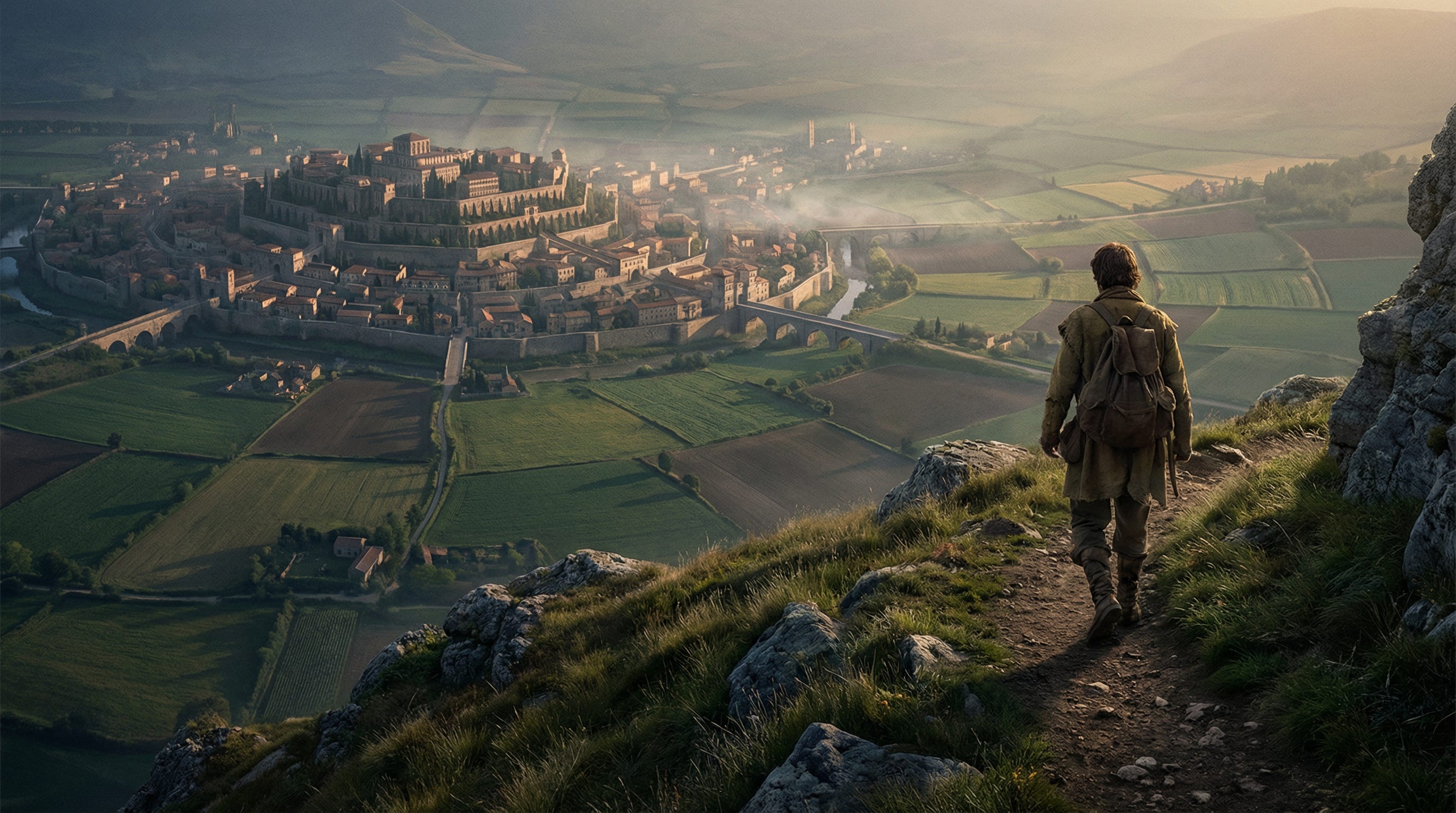
Plato’s most haunting image is the allegory of the cave: prisoners chained since childhood, watching shadows on a wall, believing the shadows are reality. One prisoner is freed, dragged up into the sunlight, and sees things as they actually are. It’s painful (the light blinds at first) and disorienting (everything he believed was wrong).
But here’s the part that gets less attention: the philosopher is obligated to go back down. He has to return to the cave, sit among the prisoners again, and try to help them see. This is the burden of knowledge. Those who understand are not permitted to simply enjoy their understanding. They owe something to the city that formed them.
The flourishing societies had people who went back down. Citizens who could have retreated into private pleasure but chose public obligation. Elites who could have extracted and hoarded but instead built and gave. Not saints (these were flawed, ambitious, often ruthless people), but people whose appetites were checked by something stronger: a sense that their own flourishing was bound up with the flourishing of the whole.
That binding is what we’ve lost, or are losing. Not the structures. The structures are still there. What’s gone is the inner architecture that made the structures work.
The question, then, isn’t whether we can design better systems. We’re clever; we can always design new systems. The question is whether we can form the kind of people capable of sustaining them. Whether we can recover the ordering of the soul that makes self-governance possible. Whether reason can retake its seat, and appetite learn its place.
That work doesn’t start with policy or politics. It starts closer to home.
Sources and Inspiration