

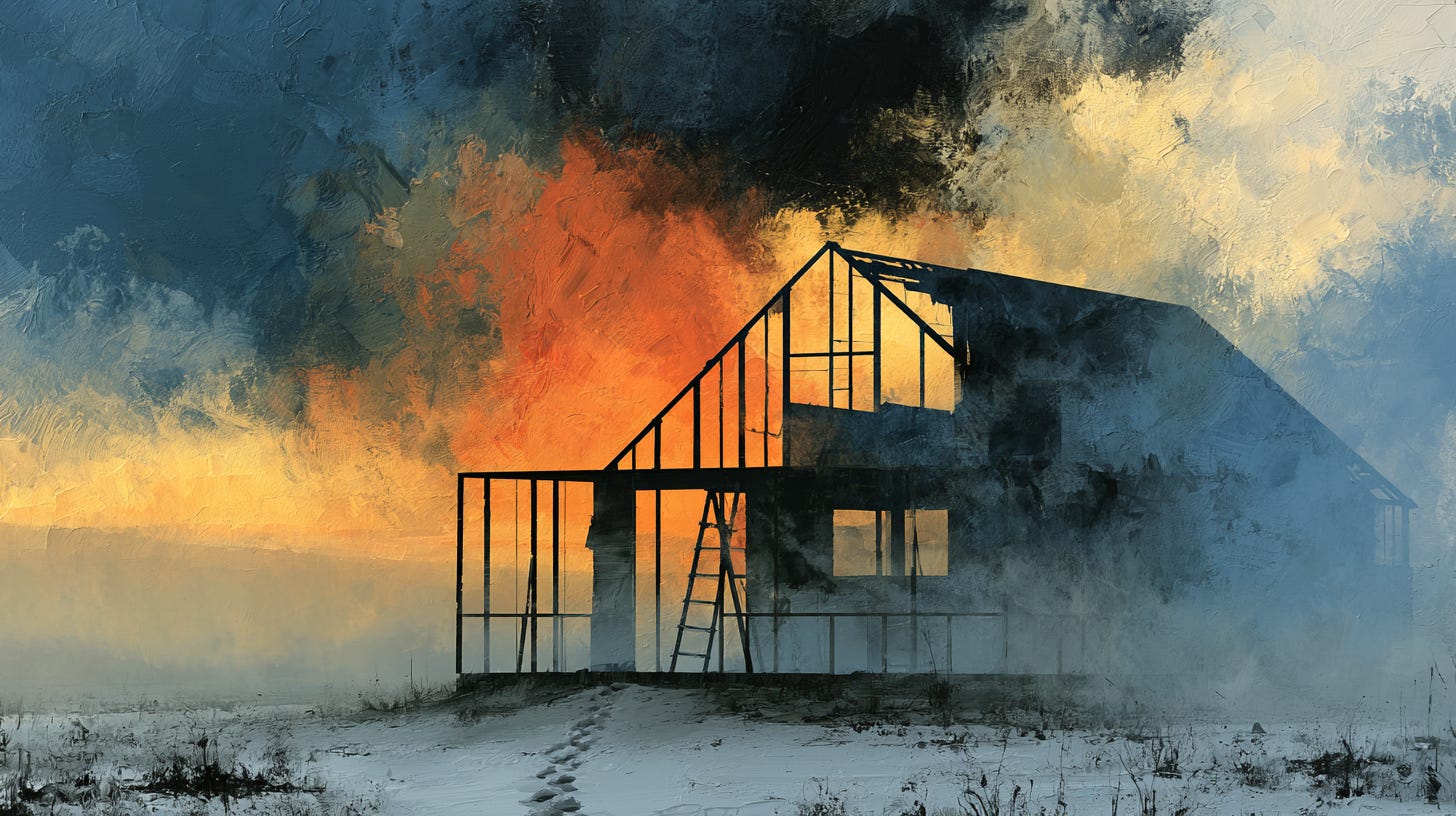
A family in my zip code needs to earn more than $186,000 a year to afford the median home. I ran the math twice because I didn't believe it the first time. Two working persons, both doing what the old script promised would be enough, looking at a house that used to signify an ordinary middle-class life. If they happen to be parents of pre-K-aged kids, one parent needs to earn all of that $186k, or the number will have to go up significantly due to exorbitant daycare costs.
That is the ground we are standing on. Groceries a third more than they cost a few years ago. Rent that swallows the raise before it lands. A war with Iran this spring that sent fuel prices surging and pushed inflation to a three-year high. A jobs report that came in at barely half of what forecasters expected. If the country feels like it is fraying, you are not imagining it, and I am not going to insult you by pretending the numbers are gentle. They are not.
Here is where I break with the vast majority.
Everyone is watching the wrong remake
The story going around is that this is the 1970s again. An oil shock out of the Middle East. Inflation that will not sit still. Not long ago the market cast Jerome Powell as ineffectual or hiding from the inflation store, calling it transitory. Then he called his inner Paul Volcker and belatedly oversaw the steepest climb in the Fed Funds rate in four decades. The yield curve inverted, the textbook promised a recession, and we all waited for the crash the rule said had to come. Then Powell handed off, and this spring Kevin Warsh took the chair, talking tough about a fresh inflation as "a burden for the American people." The market braced for the hammer to fall again.
The crash never came. The rule broke. And I think the forecasters have the right decade, the wrong ending, and the wrong read on the new man in the chair.
Start with what kind of inflation this actually is. The first wave, back in 2021, really was too much money: trillions in stimulus stacked on near-zero rates and an expanding Federal Reserve balance sheet, demand ran hot, and prices took off the way the old rule says they should. Then rates rose, demand cooled, and the worst of it came back down. What the hiking could not reach is what it left behind. Not enough houses. Not enough power. Not enough of what a growing country is trying to buy. A shortage like that is not a money problem, and it does not answer to the price of money.
You cannot raise interest rates and expect more homes.
Push rates high enough and you strangle the very supply you were trying to summon. The builder who would have broken ground can no longer finance the lot. The developer who would have added a hundred units pencils out to zero. Raise the cost of money into a housing shortage and you get fewer houses, which keeps the shortage, which keeps the prices exactly where the hiking was supposed to bring them down. Those with lower mortgage rates feel stuck or validated. Either way, they aren't moving and that further increases the stalemate of higher rates. The rate is a hammer, and the problem was never a nail.
Friedrich Hayek spent his career on one stubborn idea: the knowledge an economy runs on is scattered across millions of people and never gathers in one place, least of all in the head of whoever is trying to steer it. The planner cannot see the shortage well enough to fix it by decree. Neither, it turns out, can the central banker, working the one blunt lever he owns.
Warsh knows this, which is why the market is misreading its new central banker. It watched Powell break the last inflation with brute force, and it assumes Warsh will meet this one the same way. It has cast him as the next hawk. He does talk tough, and he means it, but the toughness has an address: the Fed's balance sheet, the multi-trillion-dollar hoard of bonds the central bank has been sitting on since the last crisis. That is the lever almost no one outside the banks and the Fed watches. On the lever everyone does watch, the interest rate, he is patient, and he keeps mentioning productivity. That is the tell. Jacking rates into a supply crunch is the one move a man who understands this economy would refuse, and Warsh understands it. When a reporter pressed him on whether he would hike at the next meeting, he did not perform certainty. He asked for "a good family fight" behind closed doors, a real debate, nothing more. The man everyone is parsing word by word is telling you he does not yet know his own answer. He is the dog who caught the car. Or he is something better than that: a man who will have the scrappy fight over strategy behind that closed door, then walk out and lock arms with the rest of the committee. That is deliberation in the old sense, the real argument in private that we have been trained to mistake for weakness.
I could be wrong about the man. He spent years as a hard-money hawk, and a hawk who means it hikes. So let me put a number on the bet: if Warsh drives the funds rate meaningfully higher through 2027 rather than holding it, I have misread him, and the recession the curve promised was only late. I don't think he will. But that is the hinge, and I would rather name it than hide it.
Define your bubble
Nobody can call this regime from the outside, because the variable that decides it is one the 1970s did not have. Artificial intelligence, and the buildout underneath it.
Say "AI boom" in a serious room and someone will say "bubble," and point to the year 2000, when telecom companies laid enough fiber-optic cable to circle the earth many times over, went bankrupt doing it, and left most of it sitting dark in the ground. It is a fair warning. It is also, I think, a misread, and the misread comes from never defining the word.
A bubble is building for demand that is not there. In 2000 they laid the cable ahead of the traffic, and the traffic took a decade to show up. That is a demand bubble, and it is the dangerous kind. What we have in 2026 is the reverse: we cannot build the thing fast enough for the demand we already have. The data centers are leased before the concrete cures. The chips are rationed. The companies buying compute are standing in line for capacity they need this quarter.
Now, is the money getting ahead of the revenue? Absolutely. The capital pouring into this is running further ahead of what it earns than telecom's did at its peak, and some of that financing is starting to eat its own tail, one company investing in the next so that the next can buy its chips. Even Sam Altman, who has more reason than anyone alive to talk his book, says out loud that someone is going to lose a phenomenal amount of money, that when bubbles happen smart people get overexcited about a kernel of truth. He is right. There is froth, and some of it will burst.
But froth on top of real demand is a different animal from a mirage. The financing can bubble; the need underneath it is not a bubble. Keep those two apart and the whole picture changes.
The froth can burst. What it is built on is not froth.
Because here is what a bust actually leaves behind. When the telecom bubble popped, the cable did not evaporate. It sat there, cheap, and became the backbone the entire modern internet was later built on top of. Every video you have ever streamed rode rails a bankrupt company laid in a mania. A bust wipes out the people who paid too much to build the thing and hands the next generation the infrastructure at a discount. The thing itself stays.
For AI, the durable residue is the power, the grid, the land, the buildings, and, cascading down the stack as newer chips arrive, a fleet of older processors that keep right on working. I will bet against the idea that these chips are dead in two or three years. The frontier models want the newest silicon, yes. But the older chips do not go to a landfill; they slide down to run the smaller, faster, cheaper models that are multiplying underneath the frontier, and they run them for years, and they run them longest wherever power is cheap, or in my basement after the price collapses.
America owns the track
Which is the one place I will let a pessimist land a real punch. Vaclav Smil, who has spent a lifetime insisting that the physical world does not move at the speed of software, would tell you that all of this runs on energy and steel and grid, and that those things change over decades, not quarters. He is right, and it is the genuine constraint on how fast any of this can happen.
It is also where America has a real edge, and the edge is abundance. When the war with Iran sent energy markets into convulsions this spring and the Strait of Hormuz became the most dangerous stretch of water on earth, our gasoline jumped, because oil is priced on a single global market and always will be. But the natural gas and the electricity that actually run a data center barely moved, while gas prices doubled across Asia and Europe. We built that capacity, and it is why the buildout can happen here at all. The compute race is a power race, and our abundance is the track we can lay for the whole world to run on.
Power is the one input we are not short of, and the whole world runs on it.
So put it together. A supply crunch you cannot fix by hiking. A Fed chair who quietly knows it and is betting on productivity. A demand-real buildout that even its bust would leave as usable track. And a country that produces the power the whole thing runs on. What you are looking at is a launchpad, if we can keep from setting it on fire.
The reckoning we are already in
I want to be honest about the "if," because there is a version of this that ends badly, and the person who taught me to take it seriously is Neil Howe. His theory is that history moves in long seasons, that every few generations a society hits a winter, a crisis that tears down the old order before a new one can grow. He would look at the war, the inflation, the fury in our politics, and say we are deep in that winter now. And he would add a warning I cannot wave away: the debt is so large this time that the usual cushion, the government spending its way through the pain, may not be there when we reach for it.
Here is my divergence, and I will own it as a bet against the narrative. Every prior American winter climaxed in total war: the Revolution, the Civil War, the Second World War. The war was never only the pain. It was the reset: it forced unity, rebuilt the institutions, cleared the old debts. Nuclear weapons may have quietly closed that door, because the great powers cannot fight the war that used to reset the board without ending the board. So the pressure goes somewhere else. It turns inward, into an economic shakeout and a fight over who we are.
That is not the same as gentle. Take away the external war and you may take away the reset while keeping the pain. The bloodiest winter this country ever had was the one it fought against itself, and a debt crisis with no cushion is a cold reckoning that can still cost everything. My bet is narrow: that this one resolves through markets and argument rather than on a battlefield. It costs us something either way.
And the shakeout may be the AI bust itself. The reckoning runs through the buildout, not around it. What the fire burns away is the froth, the overpriced money, the companies that mistook a mania for a moat. What it leaves standing is the track. And America owns the track.
The fever is downstream of the scarcity
None of this is really about your portfolio. It matters because our politics is sicker than it has been in my lifetime, and I have come to believe the sickness is downstream of the economics. When the pie stops growing, people stop building and start fighting over the slices. Scarcity is what turns a country zero-sum.
Byrne Hobart, who reads markets with a historian's eye, made the case in Boom: Bubbles and the End of Stagnation: the real enemy is stagnation, and a bubble, for all the money it torches, is how a free society coordinates its capital and its talent around a frontier worth crossing. Take away that frontier and the country turns inward and small, squabbling over what is already on the table. A boom does more than move markets; it gives a people something to build toward instead of something to take from one another.
What is truly scarce are not natural resources or new ideas but the human will and courage to unlock nature's intrinsic superabundance. There are no limits to growth, only the growth of limits.
Stop growing the pie, and all that is left is the fight over the slices.
You can see the fever on both flanks, and it is the same fever wearing two costumes. On one side, the impulse to freeze the rents and tax the builders, to redistribute a pile the movement has quietly decided is fixed. On the other, the impulse to wall the country off, to slam the door on the immigrant engineer and the foreign trade that the buildout actually runs on, to retreat into a smaller and more nostalgic past. Left and right, the shared premise is that the pile is fixed and the only question is who gets which slice.
Both are wrong for the same reason, and here is the inversion that ties this whole essay together. The thing most likely to cause the crash is not overbuilding. It is being stopped from building. Block the power plant, block the data center, turn away the engineer, freeze the price, and costs climb geometrically until the demand everyone was counting on finally breaks. The fixed-pie politics does more than slow the boom; it is the mechanism that could manufacture the bust and bloodshed. Clearing the way to build is the thing that keeps the whole structure standing.
When the extremes on both flanks harden, the temptation is to want them gone: silenced, banned, driven out of public life. I feel it too. And it is the wrong instinct, because it is the very move we are objecting to. James Madison built a republic to metabolize faction, a machine designed to beat bad ideas in the open rather than remove them by force. You defeat this the way a free country always has, by winning the argument in daylight, and by letting the recovery drain the fever that feeds the extremes in the first place. A country that is building again is a country with less to fight over.
Which brings me back to the family that cannot afford the house. A boom that shows up in the GDP figures and the stock index but never reaches that kitchen table is not a boom anyone living it will believe in. The recovery only counts when the house is buildable again, because we finally let it be built. That is the whole wager, and I am making it against the grain: we took the shock, we are living through the reckoning, and waiting on the other side is a country that builds like it means it. The pessimists are not wrong about the winter. They are wrong about the spring. The only thing that can rob us of it is the smallness that would stop us from building our way out, and that, at least, is still ours to refuse.
Sources and Inspiration
The Road to Serfdom - F.A. Hayek
How the World Really Works - Vaclav Smil
The Fourth Turning Is Here - Neil Howe
The Federalist Papers - Alexander Hamilton, James Madison, John Jay