

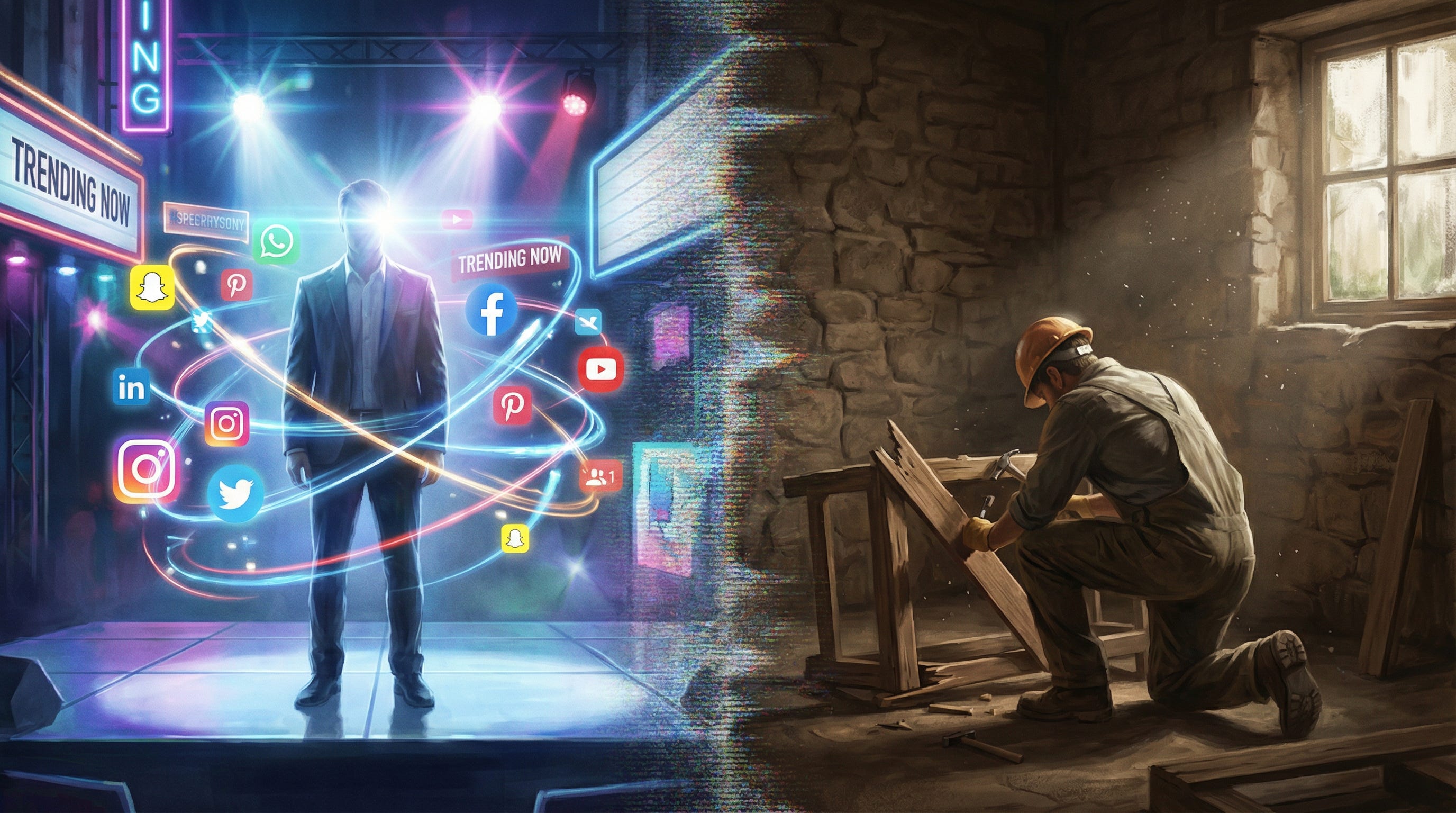
In 1961, a historian named Daniel Boorstin watched the first televised presidential debate and saw something that troubled him. Kennedy won not because his arguments were stronger but because his image was better. Nixon, pale and sweating, lost to a man who understood that the camera had become the electorate.
Boorstin spent the next year writing a book called The Image. His thesis: American culture had shifted from one rooted in reality to one dominated by manufactured images, created primarily for media consumption. He called these manufactured images “pseudo-events,” and he warned that they would eventually colonize everything—news, politics, travel, even our sense of what counts as achievement.
Sixty years later, his warning reads like prophecy.
I wrote recently about how the medium shapes the mind. Neil Postman’s argument: print culture builds the cognitive muscles for sustained reasoning, while image culture (television, then social media, then short-form video) erodes them. A population raised on fragments cannot deliberate. They can react. They cannot reason.
But Postman’s diagnosis is incomplete. Even if you could sustain attention, what would you attend to?
This is where Boorstin becomes essential. The problem isn’t just that we can’t think clearly. The problem is that there’s increasingly nothing real to think about. The information environment has been colonized by pseudo-events: content manufactured to be reported, images designed to replace the reality they claim to represent.
The double bind: we lack the cognitive capacity for careful reasoning, and the raw material for reasoning has been corrupted anyway.
A pseudo-event is planned, staged, and designed primarily to be reported. It exists because media exists, not because something actually happened.
The press conference is a pseudo-event. The journalist doesn’t attend because they want the politician’s opinion. They attend because they need something to report. The politician doesn’t speak because they have something to say. They speak because silence is absence from the news cycle.
The poll is a pseudo-event. It doesn’t measure public opinion so much as create it. The poll is reported, people read what “everyone thinks,” and then they adjust their expressed preferences to match the consensus the poll manufactured. (This is the preference falsification I wrote about recently: the feedback loop where everyone performs for everyone else, responding to a consensus that doesn’t exist until the performance creates it.)
The anniversary celebration is a pseudo-event. The hotel’s thirtieth anniversary banquet proves the hotel is important because prominent citizens attended—but they attended because a PR firm assembled them to create the impression of importance. The event is evidence of the thing it was staged to demonstrate. Circular, but invisible.
Pseudo-events are self-fulfilling. That’s what makes them powerful. And that’s what makes them corrosive: they replace reality with a manufactured substitute, and the substitute becomes indistinguishable from the real thing.
Boorstin saw this happening to people, too. He distinguished between heroes and celebrities.
A hero is someone who has actually done something—crossed an ocean, discovered a cure, led a nation through crisis, made reusable rockets a reality. Their fame follows from achievement. George Washington, the Wright brothers, Louis Pasteur, Winston Churchill, and Harriet Tubman.
People whose fame is downstream of irreversible action under real risk.
A celebrity is someone known for being known. Their fame is the achievement. Whatever they’ve done exists to justify fame that arrived first. The Kardashians are the pure case: famous initially for proximity to fame (the OJ trial, a leaked tape), now famous for being famous. The enterprise is the maintenance of visibility itself. Greta Thunberg and Tucker Carlson sit here too. Mobilizing emotion and attention without substantive argument
This is the human pseudo-event: a person who exists, in the public imagination, primarily as an image. Not someone who did something, but someone who appears as someone who did something. The representation replaces the reality.
The distinction matters because heroes extend our horizon. They show us what’s possible. Churchill proved evil could be conquered, and that knowledge enlarges everyone who encounters it.
Celebrities offer no such extension. They’re mirrors, not windows. We see ourselves reflected, our fantasies projected, but we don’t encounter anything beyond what we already are. The celebrity cannot take us anywhere new because the celebrity hasn’t been anywhere new. They’ve only been visible.
Now consider what’s happened to politics.
Boorstin warned in 1961 that politicians were becoming celebrities—that their success depended less on policy and more on televised image. He was watching Kennedy and Nixon. He couldn’t have imagined what would come.
Barack Obama was, in many ways, a celebrity president. This is not a criticism of his intelligence or his policies. It’s an observation about the nature of his appeal. “Hope and Change” was an image before it was a program. The Nobel Peace Prize arrived nine months into his presidency, awarded for not being George Bush—for the image of what he represented rather than anything he had yet done. The award was a pseudo-event: it created the significance it claimed to recognize.
In progressive circles, Obama remains celebrated rather than analyzed. The image is maintained. To interrogate what actually happened during those eight years—the drone strikes, the deportations, the financial crisis response that protected banks more than homeowners—is to commit a kind of sacrilege. You’re not supposed to look behind the image. The image is the point.
Donald Trump is the logical terminus of Boorstin’s warning: a pure celebrity who became a politician, rather than a politician who became a celebrity. His fame preceded any public achievement. The Apprentice created the image of a decisive businessman; the actual business record was more complicated. But the image was what mattered.
MAGA operates as aesthetic before ideology. The hat, the rally, the phrase—these are images that signify belonging. The rally itself is a pseudo-event par excellence: staged to be filmed, designed to demonstrate movement energy, self-fulfilling proof that the movement is energetic because look at all these people at the rally. The content of what’s said matters less than the fact of the gathering.
Both Obama and Trump understood, instinctively, that modern politics is performance first and policy second. Both cultivated images that their supporters consume and protect. Both inspire reactions that are more about the image than the record.
The costume differs. The performance is identical.
Boorstin saw the same replacement happening to travel. He noted that the word “travel” once meant the same as “travail”—trouble, difficulty, the disorientation of encountering the unfamiliar. The traveler was changed by the journey because the journey was genuinely challenging.
The tourist seeks something different: the experience of travel without the travail. A curated, comfortable encounter with “authenticity” that is itself manufactured. The guided tour. The recommended restaurant. The photo opportunity. The tourist wants to have traveled without having been changed.
This has intensified beyond what Boorstin could have imagined. The person who “travels” to Bali or Iceland or Tokyo now often brings their entire culture with them. The same apps. The same streaming shows. The same text conversations. The same algorithmic feed, served from the same servers, creating the same cognitive environment they never left.
They’ve relocated their body. They haven’t relocated their consciousness.
The Instagram photo proves they traveled. The experience exists to generate the content that demonstrates the experience happened. But the displacement that travel once provided—the genuine encounter with difference, the destabilization of assumptions, the expansion of what you thought possible—this requires leaving home in a way that keeping your smartphone in your pocket makes nearly impossible.
The image of travel has replaced travel. And we’ve stopped noticing the difference.
Where does this leave us?
The Postman diagnosis: we can no longer think clearly because the medium has atrophied the cognitive muscles for sustained reasoning.
The Boorstin diagnosis: even if we could think clearly, the information environment has been colonized by pseudo-events, manufactured images designed to replace reality.
The preference falsification trap: the pseudo-events shape the “public opinion” we then falsify our preferences to match, creating a feedback loop where no one knows what anyone actually believes.
The epistemological compound fracture: we can’t tell real from manufactured, we can’t think carefully about the distinction, and we’re performing for each other based on a consensus that doesn’t exist.
This could be the end of the analysis. Diagnosis complete. Everything is fake. We’re doomed.
But I don’t believe that.
There’s a line from Robert Anton Wilson that I think about often: “What the Thinker thinks, the Prover proves.” It was in the opening essay.
The mind works like this: some part of you decides what’s true (the Thinker), and another part finds evidence for it everywhere (the Prover). If you think the world is fake and hopeless, your Prover will build an airtight case. If you think reality is accessible and worth pursuing, your Prover will find that too.
Once you see the mechanism, you get to choose what to think. Not naively, not by ignoring evidence, but by recognizing that the Thinker-Prover loop is always running and you might as well run it deliberately. Abundantly.
The diagnosis matters because it makes the choice visible. If you don’t see the pseudo-events, you can’t choose not to consume them. If you don’t recognize the celebrity substituting for the hero, you can’t choose to seek the hero instead. If you don’t notice that you’ve brought home with you to Bali, you can’t choose to actually be anywhere other than home.
Awareness is the inoculation.
The world is filling with manufactured images. But the world also still contains reality—people who accomplish things rather than perform accomplishment, experiences that change you rather than generate content, ideas that require effort to understand and reward that effort.
These things are harder to find. They’re not optimized for attention. They don’t compete well against pseudo-events in the algorithmic feed. But they exist.
What the Thinker thinks, the Prover proves. If you decide that reality is doomed and your society is losing its direction, you will find evidence for that everywhere, and you will be right, and you will be trapped.
If you decide that reality is still there, underneath the images, waiting to be encountered by anyone willing to do the work, and there is abundance and prosperity, you will find evidence for that too. And you will be free.
The choice is yours. It always was.