

It’s no secret, dear reader, that I am a petrol head. I love cars. They are a weakness of mine, if they can be said to be such a thing. The distinction, I think, is that I don’t care what car you see me in. What is important to me is the feeling the car produces. For me, it’s intrinsic.
In such a framework, the Miata is a clear winner when compared to an F-150. The Miata is nimble. It communicates things to the driver. The cockpit has a connection to the road, the physics, the athleticism. You feel what the car is doing because the car is an extension of you. The truck insulates. The sports car implicates.
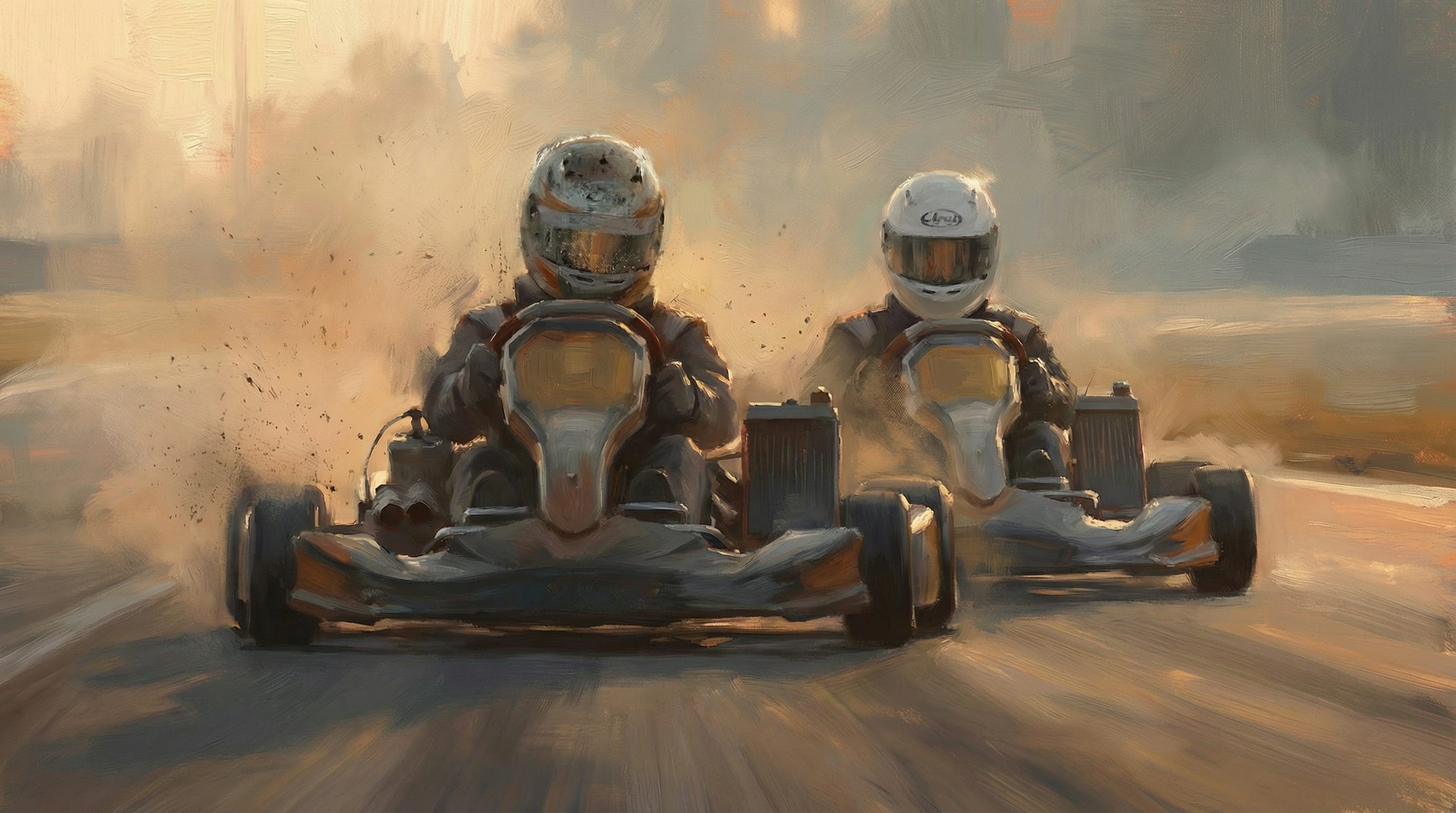
For my birthday recently, I spent time on a karting track. These karts sit just below pro-level, friendly enough for novices but serious enough to teach you something. And teach me they did.
As I slid around corners, testing different driving lines, trying to beat drivers who had a significant weight advantage, I began to see how quickly my mental resolve could be flustered by the slights of chance.
The driver ahead, with two centimeters between his bumper and mine, misses his line and hits dirt. We collide. Debris flies against my visor. I’m dragged down into the mess even though I was seconds from a decisive pass.
Others’ inherent advantage. Others’ mistakes. Others. In my way. Changing my outcome.
The narrative came fast. It felt righteous. It felt true.
But this is all part of it, no? Isn’t this precisely the capacity that we spend time learning about at The Prometheus Dispatch?
There are two selves at work in any pressured moment. Self 1 is the teller, the narrator, the judge: the voice that explains what you should be doing and critiques how you’re doing it. Self 2 is the doer: the body-mind that actually performs, drawing on accumulated learning and instinct.
The problem is that Self 1 doesn’t trust Self 2. And that distrust creates exactly the failure it fears.
In the moments after the collision, Self 1 took over completely. The narrator had the microphone. “Weight advantage. His mistake. Bad luck. Not my fault.” All of it plausible. None of it useful. While I was busy constructing a grievance, the next corner was approaching. The race was still happening. But I wasn’t in it. I was in my head, litigating.
This is the interference problem. Not that we lack capacity. That we block the capacity we have. The dirt on my visor wasn’t the obstacle. My response to it was.
Presence is the capacity to remain centered, focused, and clear when everything in the environment pulls toward reactivity. Elite performers have it. They’ve cultivated it through deliberate work on their inner state, not just their technique.
The free throw shooter who can’t miss in practice but bricks under pressure hasn’t failed to develop skill. He’s failed to develop himself.
I know this. I write about this. And still, the moment dirt flew against my visor, I became the shooter at the line, tightening against myself, letting the narrator run the show.
The gap between knowing and being is the whole game.
Inside my helmet, going down the straight, I have a second to reflect.
Deep breath in through the nose. Pursed lips forcing the exhale. I box breathe for the next few laps, falling into rhythm.
I hold my racing line. Smash the brake hard, just short of the tires squealing in release. Gentle bump on the curb. Keep the traction. Feel the thrust of g-forces on my hip bones in the shell of the seat. Meet the apex. Smash the throttle.
This is what it feels like when Self 2 drives.
No narrator. No judge. Just the body doing what it knows how to do, when the mind finally stops interfering.
The dirt on the visor can come from outside: another driver’s mistake, circumstance, bad luck. Or it can come from inside: Self 1 taking over, narrating blame, creating its own interference. Both obscure your vision. Both throw you off the line.
But both offer something else too.
Energy.
The collision happened. The frustration rose. That’s energy entering the system. The question is where it goes.
Channel it into the blame narrative, and you’ve handed it to Self 1. You’re now racing angry, tight, litigating grievances while the apex approaches.
Channel it into the breath, the rhythm, the racing line, and it becomes fuel. The frustration doesn’t disappear. It gets redirected.
There’s an aikido principle here. You don’t fight the incoming energy. You don’t pretend it isn’t there. You use it. You find your opponent (even when the opponent is your own reactivity) and redirect what they’re giving you. Energy is neither created nor destroyed. It is up to you to channel it in the most productive way possible.
The box breathing wasn’t suppression. It was redirection. Taking the heat of frustration and turning it into focus. Into presence. Into the next corner.
The last lap signal flies. I realize only one target remains in front of me. The others have all flailed somewhere along the way. I’m lapping them.
You might wonder if there were too many Self 1s on the track. A million things can go wrong on each and every lap.
I approach the chicane and brake late. Too late. A slight mistake, four tires squeal in pain, and I enter a slide.
Somehow, I don’t lose time.
I stay in it. No narration. No blame. Just the car, the physics, the correction. My hip bones.
I’m on the last driver’s tail. I decide my line and hit my mark. My bumper inches ahead of his as we cross the finish.
The classroom is everywhere. The best time to practice is in a place you’re already having fun.
Sources and Inspiration